When people think about self-defense tools, they often picture specialized equipment—pepper spray, tactical flashlights, or other gear specifically designed for protection. While those tools certainly have their place, there is another category worth considering: everyday items that can serve a defensive purpose when needed.
One such item is the carabiner.
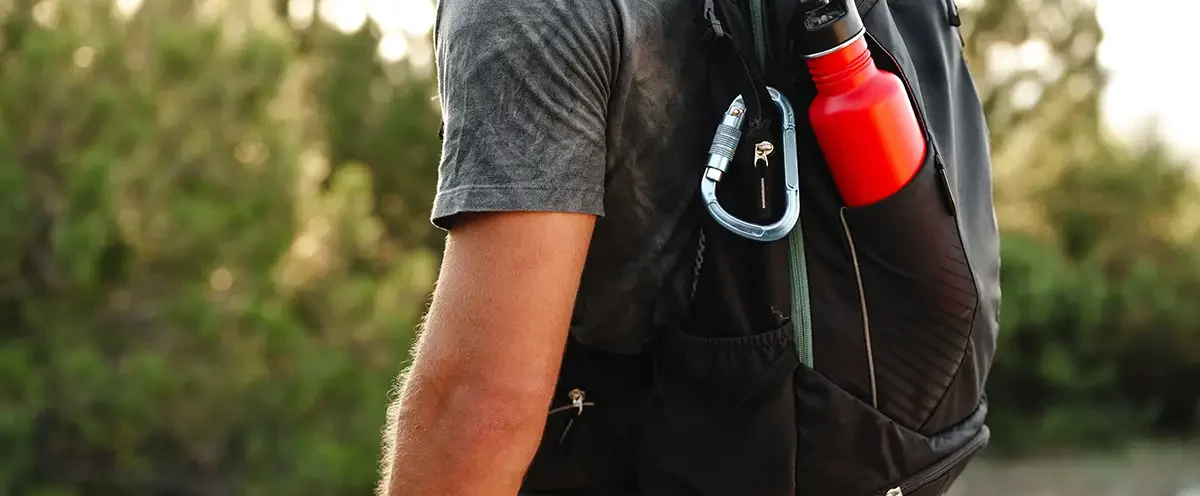
Originally designed for climbing and outdoor gear, the carabiner has become a common everyday carry item used for keys, water bottles, gym bags, and backpacks. Because it is so widely recognized as a utility tool, it can also function as a subtle, practical improvised defensive tool in situations where other items may not be allowed.
At Mindful Defense, we emphasize simple, accessible self-defense concepts—and the carabiner fits that philosophy well.
Why a Carabiner Can Be Useful for Self-Defense
A carabiner has several characteristics that make it useful as an improvised defensive tool.
1. It’s Already an Everyday Object
Carabiners are everywhere. People use them to:
- Clip keys to a belt loop
- Attach water bottles to backpacks
- Secure gym bags
- Organize gear
Because they are such a normal item, carrying one does not draw attention or signal that you are carrying a defensive tool.
This makes it especially useful in non-permissive environments—places where obvious self-defense tools may be restricted or prohibited.
Examples may include:
- Workplaces
- Office buildings
- Concert venues
- Travel environments
- Schools or campuses
While policies vary by location, a standard carabiner is generally viewed as a simple utility accessory rather than a weapon.
2. Solid Construction
Most carabiners are made from aluminum or steel, which means they are strong, rigid, and able to withstand impact without breaking.
Even lightweight keychain models provide:
- Additional mass in the hand
- A firm striking surface
- A reinforced grip
These features can help amplify natural defensive movements.
3. Easy to Access
Unlike many tools that sit in a bag or pocket, carabiners are often already in your hand when accessing keys or gear.
This immediate accessibility is critical in self-defense situations where seconds matter.
How to Use a Carabiner Defensively
A carabiner works best when used as a reinforcement to natural hand strikes rather than as a swinging object.
Grip
The simplest and most reliable method is to:
- Hold the carabiner inside a closed fist
- Allow part of the frame to extend slightly from the bottom or side of your hand
- Keep your grip tight and stable
- This essentially turns the carabiner into a compact impact reinforcement.
Avoid holding it loosely by the gate or swinging it like a lanyard, which can reduce control.
Basic Striking Motions
Focus on short, controlled movements such as:
Hammer-Fist Strike
- Strike downward with the bottom of your fist
- The carabiner reinforces the impact point
Forward Punch
A straight punch with the carabiner inside the fist adds rigidity to the strike
Short Jabs
Tight movements aimed at disrupting an attacker’s grip or advance
The goal is not prolonged combat, but creating enough disruption to break contact and move to safety.
Target Areas
In defensive situations, the most practical targets are areas that can interrupt movement or grip, such as:
- Hands and fingers
- Forearms
- Biceps
- Thighs
Strikes to these areas can create an opportunity to disengage and escape.
Potential Drawbacks of a Carabiner
While a carabiner can be a useful improvised tool, it is not perfect. Understanding its limitations is important.
1. Smaller Striking Surface
Compared to dedicated defensive tools, a carabiner has a relatively small contact area, which can reduce its effectiveness if strikes are poorly placed.
Mitigation:
Focus on tight, controlled strikes rather than large swinging motions.
Accuracy and timing matter more than raw power.
2. Grip Stability
Some carabiners have very smooth surfaces, which can make them rotate or shift inside the hand.
Mitigation:
Choose models that have:
- Textured edges
- Slightly thicker frames
- Keychain size that fits your hand comfortably
Practicing your grip ahead of time can also help build familiarity.
3. Limited Reach
Because the carabiner sits in the hand, it does not provide additional reach like a longer tool might.
Mitigation:
Use the carabiner as a force multiplier for natural movements, not as a long-range tool.
Movement, distance management, and situational awareness remain the most important elements of self-defense.
Choosing the Right Carabiner
Not all carabiners are equally suited for everyday carry.
Consider models that are:
- Solid metal (aluminum or steel)
- Large enough to grip comfortably
- Simple in design
- Durable enough to withstand impact
Avoid very small decorative models that may bend or break under stress.
Also remember that climbing-rated carabiners are designed for strength, though even non-climbing utility models can work for everyday carry.
The Mindful Defense Perspective
The carabiner isn’t a magic solution. No tool replaces awareness, judgment, and good decision-making.
But it does offer several advantages:
- It’s already part of daily life
- It can be carried without drawing attention
- It provides extra reinforcement in an emergency
- It requires minimal training to use effectively
Most importantly, it supports the core goal of self-defense: creating an opportunity to disengage and reach safety.
At Mindful Defense, we encourage people to think about the tools they already carry and how those items might support their personal safety strategy.
Preparedness doesn’t always mean carrying specialized gear.
Sometimes it simply means seeing everyday objects in a new way.