A power outage can be inconvenient, but it can also create safety and security risks that aren’t always obvious.
When the lights go out, exterior lighting disappears. Security cameras and alarm systems may stop working. Garage doors can become difficult to operate. Cell phones begin losing their charge. Traffic signals may go dark, and if an outage lasts long enough, stores, gas stations, ATMs, and other services can become unavailable.
Most power outages are uneventful. But preparedness isn’t about assuming something bad will happen. It’s about making sure you’re ready if it does.
At Mindful Defense, we believe personal safety starts long before a confrontation. Here are practical steps you can take to keep yourself, your family, and your home safer during a power outage.
1. Know Why the Power Is Out
Your first step should be gathering information.
Check your electric utility’s outage map or app using your phone. Determine whether the outage affects just your house, your neighborhood, or a much larger area.
If severe weather is involved, check local emergency alerts and weather information as well.
The expected duration matters. A 30-minute outage requires very different preparation than one expected to last overnight or for several days.
Avoid unnecessarily draining your phone battery while you’re checking for updates. Your phone may become one of your most important communication and information tools.
2. Lock Your Doors and Windows
This sounds obvious, but it’s worth physically checking.
During normal evenings, lights, televisions, vehicles coming and going, and other activity make an occupied home obvious. A widespread outage changes the environment.
Walk through the house and verify that exterior doors, accessible windows, sliding doors, and the door between your garage and house are secured.
If you normally rely on an electronic lock, understand how it operates without household power and whether it has a physical key or another backup method.
You don’t need to become fearful simply because the power is out.
You do want to maintain control over access to your home.
3. Don’t Advertise That You’re Vulnerable
If you’re home alone, there’s generally no reason for strangers outside your home to know that.
Avoid posting publicly on social media that you’re alone, your alarm isn’t working, your neighborhood is completely dark, or you’ll be without power all night.
The same principle applies when someone unexpectedly comes to your door.
You don’t have to open your door to determine who is there.
Use a window, peephole, doorbell camera if it’s operating, or simply speak through the closed and locked door.
A power outage doesn’t change one of the simplest home-security rules:
A locked door should remain locked until you have a good reason to open it.
4. Have Multiple Sources of Light
Don’t rely exclusively on your phone’s flashlight.
Ideally, your home should have several readily accessible battery-powered light sources, including flashlights, headlamps, lanterns, and rechargeable emergency lights.
A headlamp is particularly useful because it keeps both hands free.
Consider keeping a flashlight in predictable locations such as your bedroom, kitchen, basement, and near the primary exit.
You should be able to find at least one of them in complete darkness.
Be cautious with candles. Open flames introduce an unnecessary fire risk, especially when people are moving around a dark home.
5. Understand What Happens to Your Security System
Don’t assume your alarm and cameras stopped working just because your electricity did.
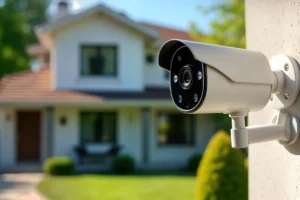
Many professionally installed security systems include backup batteries, and some systems have cellular communication that continues operating even when your home’s internet connection is down.
Other devices may stop functioning immediately.
Know the answer before an emergency.
Determine which security devices have battery backup, how long that backup typically lasts, whether cameras continue recording, whether your alarm can communicate without internet service, and what happens to smart locks and garage-door equipment.
If security is important to you, consider putting critical networking equipment such as your modem, router, or security hub on an appropriately sized uninterruptible power supply (UPS).
6. Secure Your Garage
The garage is easy to overlook.
An electric garage-door opener may not function normally during an outage. Learn how your opener’s emergency release works and how to manually open and secure the garage door.
If you manually disengage the opener, don’t automatically assume the door is secure afterward.
Also keep the interior door connecting your garage to your house locked.
7. Preserve Your Phone Battery
At 100% charge, your phone is a tremendous resource.
At 2%, it isn’t.
During an extended outage, reduce screen brightness, use Low Power Mode, limit unnecessary streaming and social media use, and turn off features you’re not using.
Keep charged power banks available, and periodically check their charge levels rather than leaving them forgotten in a drawer for years.
A vehicle may also provide a charging option when it can be used safely.
8. Keep Emergency Supplies Together
You shouldn’t have to search through your house in the dark for everything you need.
Consider creating a dedicated power-outage kit containing items such as:
- Flashlights and headlamps
- Spare batteries
- Battery-powered lantern
- Charged power banks and charging cables
- Battery or hand-crank emergency radio
- First-aid kit
- Bottled water
- Shelf-stable food
- Necessary medications
- Emergency contact information
- Basic tools
Periodically inspect the kit and replace expired batteries, food, medications, or other supplies as appropriate.
9. Be More Cautious About Unexpected Visitors
A knock at the door during an outage isn’t automatically suspicious.
It could be a neighbor checking on you, a utility worker, or someone who genuinely needs assistance.
But you don’t have to abandon normal safety precautions because someone’s story sounds urgent.
Keep the door locked while you communicate. If someone claims to represent the utility company, police, fire department, or another organization and something doesn’t seem right, independently verify their identity.
Don’t use a phone number provided by the person at your door. Find the organization’s official number yourself.
If someone attempts to force entry, call 911 and move yourself and other occupants to the safest available location.
10. Don’t Go Outside Just to Investigate
If you hear something unusual outside, resist the urge to immediately walk into the darkness to find out what it was.
Observe from a secure location when possible.
There is an important Mindful Defense principle at work here:
You don’t need to investigate every potential problem.
Avoiding an unnecessary encounter is often the safest decision you can make.
11. Be Extremely Careful With Generators
Generators can be lifesavers during extended outages, but improper operation can be deadly.
Never operate a portable generator inside your home, basement, garage, shed, or another enclosed or partially enclosed area.
Carbon monoxide is colorless and odorless.
Follow the generator manufacturer’s instructions and current safety recommendations regarding outdoor placement, ventilation, connections, and fuel storage. Make sure your home has functioning carbon-monoxide detectors with battery backup.
Never attempt to power your house by plugging a generator into a household outlet. Improper connections can create electrocution and fire hazards and endanger utility workers.
If you want a generator capable of powering household circuits, have the appropriate equipment installed by a qualified electrician.
12. Avoid Unnecessary Travel
A widespread outage can make driving considerably more hazardous.
Streetlights may be out. Traffic signals may not function. Businesses may be closed. Downed trees and power lines can block roads.
Unless you have a good reason to leave, remaining safely at home may be the better option.
If you do leave, slow down and pay particular attention when approaching intersections with nonfunctioning traffic signals. Follow local traffic laws and emergency instructions.
Never approach a downed power line. Assume every downed line is energized.
13. Have a Family Communication Plan
If everyone isn’t home when the outage begins, know how you’ll communicate.
Decide in advance who will contact whom, where you’ll meet if communication fails, who is responsible for children or dependent family members, and which relative or friend outside your immediate area could serve as a backup contact.
Text messages may sometimes get through when cellular networks are congested and voice calls do not.
Also teach children what to do if the lights go out rather than waiting until they’re frightened in a completely dark house.
14. Prepare Before You Need Any of This
The best time to prepare for a power outage is when the lights are still on.
Tonight, ask yourself:
Could I safely operate inside my home for 24 hours without electricity?
Can you find a flashlight in complete darkness?
Do you have charged power banks?
Do you know whether your alarm works without power?
Can you manually operate and secure your garage door?
Do you have working smoke and carbon-monoxide detectors with battery backup?
Does everyone in your household know what to do?
If the answer to some of these questions is no, fix those vulnerabilities now.
Awareness Is Your First Line of Defense
A power outage doesn’t mean you’re suddenly in danger.
It does mean some of the systems you normally rely on may no longer be available.
The goal isn’t to become paranoid or spend the night staring through the blinds.
It’s to recognize that your environment has changed, adjust accordingly, and avoid putting yourself into unnecessary situations.
That’s the essence of Mindful Defense.
Preparation gives you options.
Awareness gives you time.
And good decisions can prevent a dangerous situation from developing in the first place.
Be S.A.F.E. — Strong. Aware. Focused. Empowered.